Section I — What Deep Value Investing Really Is
Deep value investing is not traditional value investing.
It is not about buying "good companies" at modest discounts, nor is it about precision valuation models that assume stable futures. Deep value investing operates where uncertainty is extreme, information is scarce, and consensus has already priced in failure.
In these environments, prices are not wrong by a few percent — they can be wrong by multiples.
Deep value focuses on assets that are:
- Emotionally abandoned
- Structurally misunderstood
- Priced for permanent decline or failure
The objective is not perfection.
The objective is mispriced survival.
Section II — Why Deep Value Exists
Markets are efficient where:
- Liquidity is high
- Coverage is dense
- Capital is abundant
- Career risk is low
Markets are inefficient where:
- Liquidity is poor
- Coverage is minimal or nonexistent
- Narratives are ugly
- Outcomes appear binary
Large institutions are structurally unable to operate in these areas.
Retail investors — independent, flexible, and unconstrained — are not.
This is where deep value opportunities live: below consensus, not above it.
"The consensus view is already built into the price." — Ray Dalio
Deep value investing begins where consensus ends.
Section III — Redefining "Value"
Traditional value investing relies on estimating intrinsic value and buying at a discount.
Deep value rejects false precision.
In many distressed or ignored companies:
- Future cash flows are uncertain
- Business models are cyclical or disrupted
- Outcomes range from bankruptcy to multi-bagger
In these cases, debating whether fair value is $10 or $14 is irrelevant.
What matters is asymmetry:
- Limited additional downside (already priced in)
- Significant upside if survival or normalization occurs
This philosophy was articulated clearly by Keith Gill, who emphasized that valuation accuracy matters far less than understanding how wrong the market might be.
Section IV — Asymmetric Risk: The Core Advantage
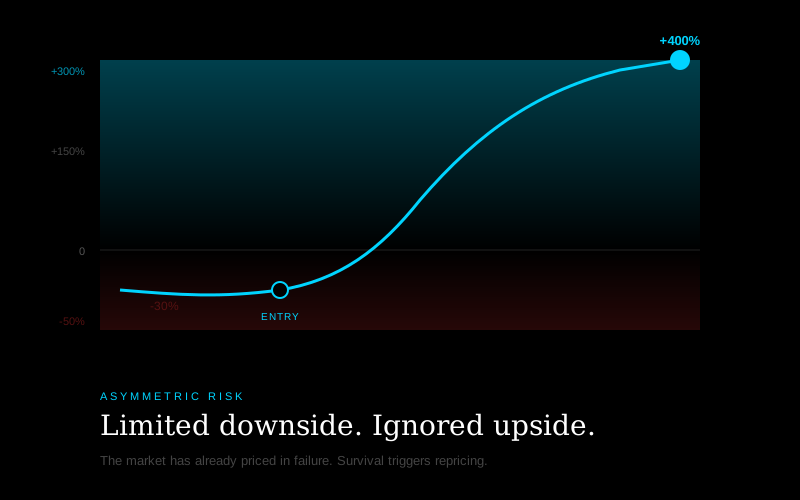
Deep value investing is not about avoiding risk.
It is about structuring risk so it works in your favor.
The ideal deep value setup looks like this:
- Downside: Known, finite, often already assumed
- Upside: Ignored, dismissed, or ridiculed
- Probability: Skewed by time, not prediction
These opportunities often exist near:
- Perceived insolvency
- Sector-wide pessimism
- Cyclical troughs
- Narrative exhaustion
"We are card counters at the blackjack table. And we're going to turn the odds on the casino." — Billy Beane
When perception shifts from "dead" to "surviving", repricing can be violent and rapid.
Section V — Survival First: Credit Over Valuation
In deep value, credit analysis matters more than valuation.
The primary question is not:
"Is this company cheap?"
It is:
"Can this company survive long enough for the market to be wrong?"
Key survival indicators include:
- Cash runway and liquidity
- Debt maturity schedules
- Bond yields and credit ratings
A company issues bonds to raise money. Those bonds are given a rating based on how safe they are. The safer they are, the lower their yield. Higher yields imply higher risk.
Two places to find useful credit information:
- Looking up a company's credit rating by searching the company ticker and "credit rating" (ratings are commonly issued by agencies such as Moody's Investors Service): moodys.com
- Checking whether a company has publicly traded debt using FINRA's Bond Lookup: finra.org/finra-data/fixed-income
Companies priced for bankruptcy that merely survive often deliver the highest returns — not because they thrive, but because expectations were catastrophically low.
Section VI — Insider Behavior as Signal
One of the strongest non-quantitative signals in deep value investing is clustered insider buying.
Insiders may sell for many reasons:
- Diversification
- Taxes
- Personal liquidity
They buy for one reason only:
They believe the stock is materially undervalued.
Multiple executives buying meaningful amounts of stock within a short time window is a powerful indicator that internal expectations diverge from market pricing.
You can check insider transactions using OpenInsider: openinsider.com
In neglected and distressed companies, insider conviction often precedes major repricing.
Section VII — Cycles, Narratives, and Human Error
Markets consistently extrapolate trends linearly.
- Growth is assumed permanent.
- Decline is assumed irreversible.
This creates opportunity.
Many deep value investments exist in:
- Cyclical industries at trough conditions
- Businesses temporarily impaired by macro forces
- Companies punished for past mistakes rather than future realities
Human psychology struggles with non-linear outcomes.
Deep value investing exploits this weakness.
Section VIII — Liquidity, Coverage, and Opportunity
Deep value thrives where:
- Trading volume is thin
- Analyst coverage is absent
- Institutional ownership is low
One research platform for reviewing financial ratios and fundamentals is Ticker Terminal: tickerterminal.com
These conditions are uncomfortable — but essential.
Low liquidity and low attention allow prices to drift far from reality.
They also prevent large capital from arbitraging inefficiencies away.
Complexity, illiquidity, and obscurity are features, not flaws.
Section IX — Positioning and Portfolio Construction
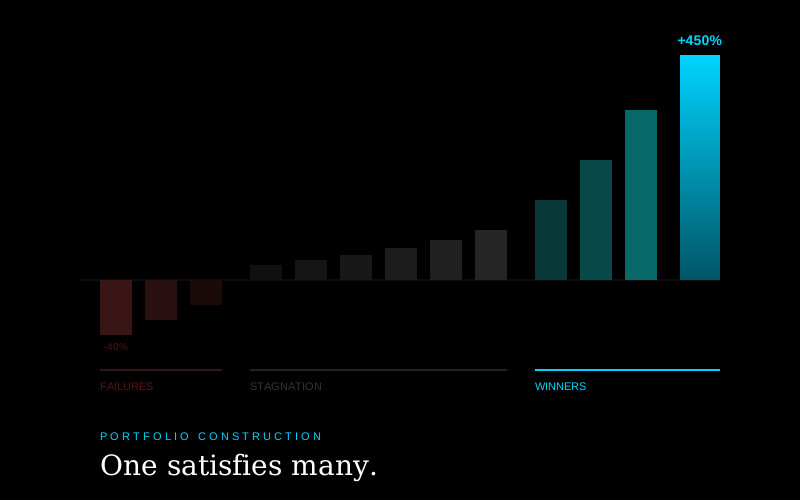
Deep value portfolios are not concentrated on certainty.
They are diversified across uncertain but asymmetric bets.
Typical construction principles:
- 15–20 positions
- Expect some failures
- Accept stagnation in many
- Rely on a few extreme winners
One multi-bagger can outweigh numerous small losses.
This is not traditional diversification — it is asymmetric diversification.
Section X — Equity First, Options Selectively
Equity ownership is the foundation of deep value investing.
Options may be used selectively when:
- Mispricing is extreme
- Duration is sufficient
- Liquidity allows rational execution
However, options introduce additional risk layers.
In most deep value situations, shares provide superior risk-adjusted exposure.
Leverage is a tool — not a requirement.
Section XI — Why This Strategy Persists
Deep value investing remains effective because it is:
- Research-intensive
- Emotionally demanding
- Time-consuming
- Illiquid
- Unscalable
These characteristics deter institutions and discourage most individuals.
The inefficiency persists precisely because participation is limited.
Section XII — The Cost of Entry
Deep value investing is not glamorous.
The work involves:
- Reading financial statements
- Analyzing credit risk
- Understanding business failures
- Operating without validation
- Waiting without certainty
The reward is not consistency — it is magnitude.
Closing Perspective
Deep value investing is a discipline of independence.
It requires:
- Thinking where others will not
- Buying when others refuse
- Waiting when others capitulate
It is not about being right often.
It is about being paid disproportionately when you are.
"You can't beat the Yankees by trying to be the Yankees." — Billy Beane