Section I — The Market Is Not a Debate; It Is a Plumbing System
Most retail participants experience markets as narrative: headlines, earnings, analyst opinions, sentiment indicators.
This is a misunderstanding.
Price is not the output of collective wisdom. Price is the output of a system that must continuously:
- Provide liquidity across instruments
- Manage inventory within risk limits
- Hedge derivative obligations
- Meet settlement requirements on fixed schedules
- Optimize balance sheet utilization
This system has a structural advantage: it is designed to function profitably even when most participants are wrong about direction.
Understanding price without understanding plumbing is like understanding poker without understanding that the house takes a rake on every hand — regardless of who wins.
Section II — The House and the Player
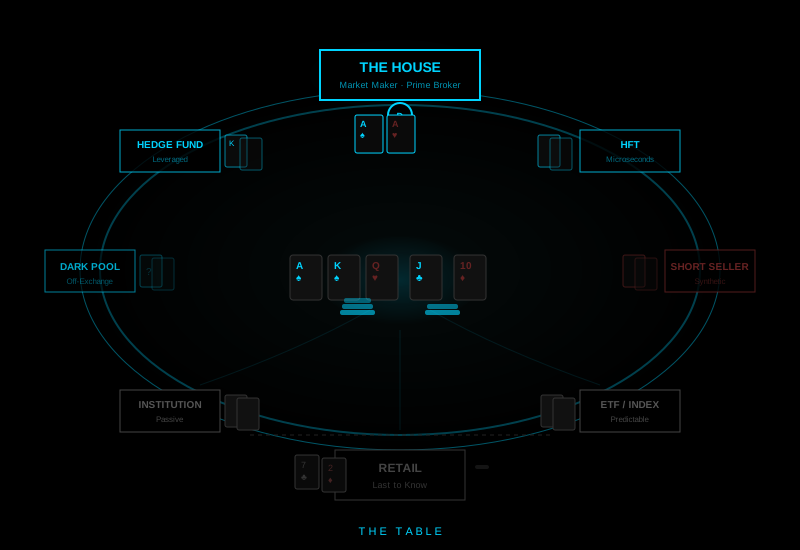
Retail traders behave like poker players.
They select positions, size bets, and hope subsequent price movement validates their thesis.
Dealers, market makers, and prime brokers behave like the house. They do not require directional accuracy. They require:
- Order flow
- Spread capture
- Financing income
- Hedging efficiency
- Information asymmetry
The distinction is fundamental:
Retail takes directional risk and hopes for favorable outcomes.
The house takes managed exposure — hedged across instruments, netted across clients, and monetized through structure rather than prediction.
The game is not rigged in the crude sense. It is architected. Every rule, every fee, every timing mechanism exists because someone designed it to exist.
Section III — Derivatives: The Control Layer Above Equity
To understand modern equity markets, you must understand that stocks are no longer the primary arena.
Derivatives — options, swaps, futures — are the control layer that sits above equity and dictates much of its behavior.
Options and Dealer Hedging
When a market maker sells an option, they inherit exposure that must be hedged. This hedge is dynamic — it changes as price, volatility, and time evolve.
Key exposures:
- Delta: Sensitivity to price. Dealers hedge by buying or selling the underlying stock.
- Gamma: Sensitivity of delta to price movement. High gamma forces continuous hedging activity.
- Vega: Sensitivity to implied volatility. Changes in expected volatility alter option values and hedging needs.
When dealers are short gamma, price movements force them to trade in the direction of the move — buying as price rises, selling as price falls. This amplifies volatility.
When dealers are long gamma, the opposite occurs — they sell into strength and buy into weakness, dampening volatility.
The distribution of gamma exposure across strikes creates mechanical support and resistance levels that have nothing to do with fundamental value.
Equity Total Return Swaps
An equity total return swap (TRS) replicates the economic exposure of owning — or shorting — a stock without requiring actual ownership or borrow.
Structure:
- Party A receives the total return of the reference equity (price movement plus dividends)
- Party B receives a financing leg (floating rate plus spread)
- Cash flows are exchanged periodically. At reset, positions are marked and settled.
This accomplishes several things:
- Leverage: Notional exposure far exceeding capital deployed.
- Opacity: Synthetic ownership often falls outside public disclosure requirements.
- Flexibility: Positions can be created, modified, and unwound without market execution.
When a large swap position is created, the dealer's hedge creates real buying or selling pressure. When the swap is unwound, the hedge unwind creates the opposite pressure. This is not opinion — it is mechanical.
Section IV — How Short Interest Is Hidden
Reported short interest represents only a fraction of actual bearish exposure. Sophisticated funds use multiple mechanisms to obscure their positioning.
Equity Total Return Swaps
- A fund enters a swap where they receive the inverse return of a stock — economically identical to a short position.
- The prime broker hedges by shorting the actual shares.
- The short interest is attributed to the broker's hedge book, not the fund.
- The fund's exposure appears nowhere in public filings.
Options Structures
- Buying puts or selling calls creates synthetic short exposure.
- A married put (long shares plus long puts) can mask a directional bet as a "hedged" position.
- Complex multi-leg structures (conversions, reversals, boxes) can create net short exposure with no reported short interest.
- Market makers hedge these positions, but the original fund's intent is obscured.
ETF Arbitrage
- ETFs can be shorted while the underlying basket is purchased.
- Alternatively, ETF shares can be created and immediately sold short.
- Authorized participants can exploit creation/redemption mechanics to generate synthetic short exposure across many names simultaneously.
- Short interest in the ETF does not appear as short interest in the underlying components.
Offshore and Subsidiary Structures
- Positions can be held through offshore entities with different reporting requirements.
- Swaps executed with non-US counterparties may fall outside domestic disclosure rules.
- Subsidiary funds with shared management can distribute positions to avoid concentration thresholds.
Failures to Deliver
- A persistent fail-to-deliver is economically similar to a short position.
- The seller has received cash but not delivered shares.
- Regulatory penalties for fails are often cheaper than borrow costs.
- This creates an incentive to "fail strategically" rather than locate borrows.
When you look at reported short interest, you are seeing the tip of an iceberg. The actual bearish exposure — through swaps, options, ETFs, offshore structures, and settlement failures — can be multiples of what is disclosed.
Section V — Basket Shorting: How Funds Target Multiple Companies
Sophisticated short sellers rarely target individual companies in isolation.
They construct baskets — groups of securities selected by shared vulnerability.
But a basket is not a "theme."
A basket is a structure.
It is financed, hedged, netted, and maintained across time — often through:
- Basket swaps / total return swaps
- Options overlays
- ETF mechanisms
- Prime broker financing and internal netting
This is where the real advantage appears:
Once a basket is large, the trade stops being "a view."
It becomes a machine.
Why Baskets?
- Diversification: No single position determines fund performance.
- Correlation: Baskets reduce idiosyncratic risk — until they don't.
- Narrative cover: "Sector thesis" justifies pressure across many names.
- Execution efficiency: One framework, many targets, repeatable playbook.
Target Selection Criteria
A typical basket might screen for:
- High debt-to-equity: Refinancing vulnerability.
- Near-term maturities: Forced dependence on capital markets.
- Weak or declining free cash flow: Fragile survival timelines.
- Low institutional ownership: Less sponsorship, less defense.
- Small float: Easier to move, harder to stabilize.
- Sector headwinds: Narrative amplification becomes easier.
- Weak governance: Low resistance to pressure campaigns.
The screening identifies not merely "bad businesses," but businesses where decline can be accelerated through capital markets friction.
The Missing Mechanic: How "Basket Errors" Happen
Baskets are built on a model: correlation, fragility, and predicted decay.
Reality is not obligated to respect the model.
Basket "errors" occur when one name stops behaving like the basket expects.
Common triggers:
- A turnaround starts working
- Liquidity changes (retail attention, reflexive demand)
- Capital structure improves (cash, buybacks, debt reduction)
- The company survives longer than the thesis timeline
- The stock becomes unborrowable at scale
The basket expected a corpse.
It got a heartbeat.
Why It's Not Easy to Remove the Wrong Name
At small size, removing a name is just a trade.
At large size, removing a name is an unwind.
An unwind is not a decision. It is a cascade:
- Reduce exposure → dealer hedges adjust
- Hedges adjust → price moves
- Price moves → volatility moves
- Volatility moves → margin moves
- Margin moves → financing tightens
- Financing tightens → the unwind becomes forced, not chosen
So the "error" persists.
They can't take it out cleanly because the structure was never designed to exit gracefully.
It was designed to press.
The Narrative Layer (Incentive Structure)
When a position cannot be exited cleanly, there is a natural incentive to keep the environment hostile:
- Keep sponsorship low
- Keep confidence weak
- Keep the company's access to capital expensive
- Keep headlines aligned with fragility
This does not require a cartoon conspiracy.
It is simply how incentives behave inside a leveraged short structure.
The Extreme Version: Bankrupt-the-Company Economics
Short campaigns do not need to "predict" bankruptcy to profit.
They benefit from anything that increases the probability of bankruptcy.
Because bankruptcy is the cleanest close-out:
- Equity goes to zero
- Shorts settle at maximum profit
- The story becomes "we were right"
In some cases, pressure is not only external. It can be internal:
- Governance failures
- Management misalignment
- Strategic sabotage through incentives and capital constraints
You do not need to claim every case is engineered.
You only need to recognize that the system rewards failure.
Baskets explain why unrelated stocks move together. They are connected not by fundamentals, but by shared financing structures, shared hedging flows, and shared prime broker plumbing. When one name breaks correlation and survives, it becomes the error that the machine cannot easily remove.
Section VI — Anatomy of a Short Campaign
A coordinated short campaign unfolds in phases, often spanning years.
Phase 1: Accumulation (Months 1-6)
- Short positions are established gradually to avoid detection.
- Swaps are preferred over direct shorts for opacity.
- Options positions are layered to create additional leverage.
- Borrow is secured from multiple prime brokers to avoid concentration.
- The target company is unaware anything unusual is occurring.
Phase 2: Narrative Seeding (Months 6-12)
Research reports highlighting concerns are published. These may come from:
- Short-biased research firms (some legitimate, some funded by short sellers)
- Anonymous reports on financial blogs
- Journalists who receive "tips" from interested parties
- Social media accounts that amplify negative narratives
The goal is not immediate price decline. The goal is to:
- Establish a public record of concerns
- Discourage potential long investors
- Prime analysts and rating agencies to scrutinize the company
The company may not even notice — the coverage appears organic.
Phase 3: Capital Starvation (Months 12-24)
As the narrative takes hold:
- Equity issuance becomes difficult. Who wants to buy stock in a "troubled" company?
- Debt issuance becomes expensive. Credit spreads widen as rating agencies cite "concerns."
- Convertible issuance attracts arbitrageurs who short stock against long convert positions.
- Existing credit facilities may face covenant pressure or renewal risk.
The company finds itself unable to access capital at reasonable terms precisely when it needs capital to invest, restructure, or weather challenges.
Phase 4: Reflexive Decline (Months 24-36)
The perception of decline creates conditions that accelerate actual decline:
- Customers hesitate on long-term contracts.
- Suppliers tighten trade terms.
- Employees — especially talent — leave for stable competitors.
- Partners reconsider relationships.
- Acquisition interest (if any) evaporates as buyers wait for further distress.
The stock price decline is no longer driven by short selling. It is driven by fundamental deterioration that the short campaign helped engineer.
Phase 5: Extraction (Months 36+)
Endgame scenarios include:
- Bankruptcy: Existing equity is eliminated. Short positions close at maximum profit. Assets are acquired at distressed valuations, sometimes by entities connected to the short sellers.
- Distressed acquisition: The company is sold to a buyer at a fraction of prior value. Shorts cover into the deal.
- Slow liquidation: The company sells assets piecemeal, with value flowing to creditors rather than equity holders.
The short campaign does not merely predict decline. It constructs the conditions for decline. This is not conspiracy — it is incentive structure. When significant capital profits from failure, resources flow toward engineering that failure.
Section VII — Prime Broker Coordination
Prime brokers sit at the center of this system.
A single prime broker may:
- Finance long positions for Fund A
- Finance short positions for Fund B
- Hold swap exposure for Fund C
- See aggregate positioning across all clients
This creates information asymmetry:
- The broker knows who is long, who is short, and where the crowded trades are.
- No individual fund has this view.
- The broker can manage their own book with this information.
When multiple funds short the same basket through the same broker:
- The broker sees the aggregate exposure.
- The broker can net hedges, reducing costs.
- The broker can coordinate borrow, improving availability.
- The broker earns fees from all participants.
This is not illegal coordination. It is structural coordination — the architecture of the system enables it.
Prime brokers are not neutral infrastructure. They are information-advantaged participants who profit from facilitating activity on both sides.
Section VIII — Failures to Deliver and Settlement Exploitation
A Failure to Deliver (FTD) occurs when securities are not delivered by settlement date.
Most people treat this like trivia.
It is not.
FTDs matter because:
- Settlement is mandatory, not optional
- Fails create obligations that must be resolved
- Resolution can force buying independent of fundamentals
What an FTD Really Represents
An FTD is not a headline.
It is a missing share inside the settlement system.
The economic reality is simple:
- A sale occurred
- Cash changed hands
- Delivery did not occur on time
- The obligation remains open until resolved
This is why FTDs are structurally similar to short exposure:
A participant has received the proceeds, but the share is not delivered.
The Settlement Reality: Netting and Delay
Modern markets do not settle trade-by-trade in a clean line.
They settle through netting systems.
Netting compresses countless trades into fewer obligations.
This creates two effects:
- Settlement can appear clean until it isn't
- Fails can persist and roll as obligations net and re-net
So you are not watching a single transaction fail.
You are watching a system carry an unresolved obligation forward.
How FTDs Are Created
FTDs can occur for multiple operational reasons.
But the mechanism that matters for structure is this:
- Someone sells shares
- They cannot source shares in time
- The system records a fail
- Close-out rules eventually force resolution
And here is the uncomfortable part:
If borrow is expensive and enforcement friction is weak, incentives form.
The system begins to tolerate fails as a cost of business.
"Locate" vs "Deliver"
The market speaks in paperwork.
Reality speaks in delivery.
A locate is not delivery.
A locate is permission to attempt delivery.
When the gap widens between "permission" and "delivery," fails grow.
Strategic Exploitation (What It Looks Like in Practice)
The play is not "naked short forever."
The play is:
- Push the edge of settlement rules
- Maintain pressure through rolling obligations
- Use exemptions and complexity as cover
- Rely on the fact that the public sees delayed, incomplete data
Then, if a close-out wave hits, the same structure can flip:
- Forced buying creates price spikes
- Spikes create margin stress
- Margin stress creates covering
- Covering creates reflexive acceleration
This is the mechanical core of certain squeezes:
Not "fundamentals."
Settlement + leverage + deadlines.
What FTD Data Can and Cannot Tell You
FTD data is not a verdict.
It is a signal.
It can suggest:
- Settlement stress
- Sourcing difficulty
- Structural imbalance
It cannot prove intent by itself.
That is why clustering matters:
Elevated fails + rising borrow + aggressive options positioning + repeated narrative pressure
This is where structure shows its hand.
Suggested Reference
If you want a hard-edged thesis on the darker interpretation of this system:
Susanne Trimbath's Naked, Short and Greedy argues that chronic fails and settlement opacity are not accidents — they are features of a system designed to preserve advantage for those closest to the plumbing.
FTDs are not "noise." They are the footprint of a settlement system carrying unresolved obligations forward — and when those obligations collide with deadlines, the market can move violently without any change in fundamentals.
Section IX — Why Institutions Win
Institutional participants win not because they predict better.
They win because they:
- Design the system: Rules and regulations reflect institutional input.
- Control liquidity: Market making provides visibility into flow.
- Manage exposure across layers: Derivatives, synthetics, and financing are coordinated.
- Understand deadlines: Settlement, expiration, and regulatory requirements are known precisely.
- Access information asymmetry: Aggregate positioning across clients provides insight unavailable to individuals.
Retail participants trade outcomes.
Institutions trade structure.
This is not illegal. It is architectural.
Section X — Recognizing the Pattern
For investors, recognizing these dynamics is the first defense.
Warning signs that a company may be a basket target:
- Sudden increase in borrow cost without news.
- Elevated FTDs appearing in SEC data.
- Short-biased research reports from unfamiliar sources.
- Coordinated negative coverage across multiple outlets.
- Difficulty accessing capital markets despite adequate fundamentals.
- Stock moving in lockstep with unrelated names.
None of these signals is definitive. But clustering is informative.
Section XI — The Limits of Disclosure
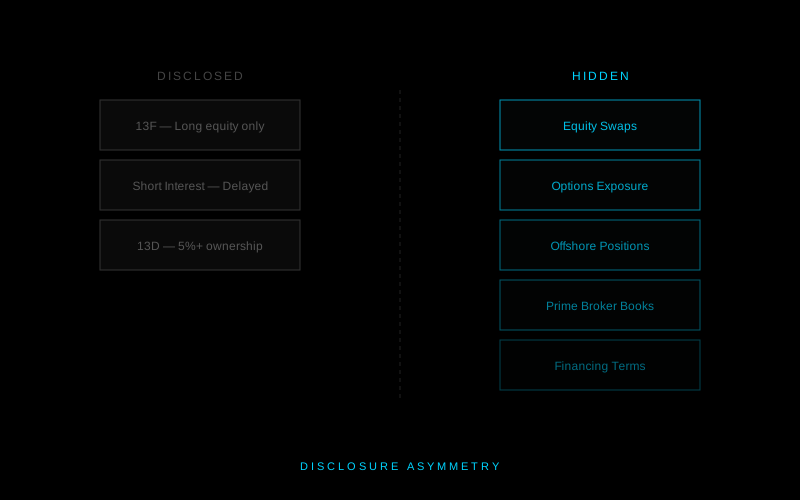
Regulation requires disclosure — but disclosure has limits.
- 13F filings: Quarterly snapshots of long equity positions. No derivatives, no shorts, no swaps.
- Short interest: Published twice monthly, with delay. Does not include synthetic exposure.
- Form 13D/13G: Required at 5% beneficial ownership. Swap exposure may not count toward this threshold.
- Form SHO: Requires disclosure of large short positions in some jurisdictions, but US requirements remain limited.
The result: public data shows you a partial picture, delayed, with the most sophisticated exposures excluded entirely.
"When does telling the truth ever help anybody?" — War Dogs
In this system, opacity is a feature — not a bug. Those who design the architecture benefit from asymmetric information. Disclosure is calibrated to satisfy regulatory minimums while preserving informational advantage.
Closing Perspective
Understanding structure does not guarantee returns.
Markets remain difficult, and structural awareness does not eliminate risk.
But ignoring structure guarantees something worse: you are playing a game whose rules were written by others, for their benefit, with your capital.
The house does not win because it predicts better.
The house wins because it built the casino.
Knowing the architecture is the first step to not being the mark at the table.
"It ain't what you don't know that gets you into trouble. It's what you know for sure that just ain't so." — Mark Twain